1040. Maximum Binary Tree Ii
Difficulty: Medium
LeetCode Problem View on GitHub
1040. Maximum Binary Tree II
Medium
A maximum tree is a tree where every node has a value greater than any other value in its subtree.
You are given the root of a maximum binary tree and an integer val.
Just as in the previous problem, the given tree was constructed from a list a (root = Construct(a)) recursively with the following Construct(a) routine:
- If
ais empty, returnnull. - Otherwise, let
a[i]be the largest element ofa. Create arootnode with the valuea[i]. - The left child of
rootwill beConstruct([a[0], a[1], ..., a[i - 1]]). - The right child of
rootwill beConstruct([a[i + 1], a[i + 2], ..., a[a.length - 1]]). - Return
root.
Note that we were not given a directly, only a root node root = Construct(a).
Suppose b is a copy of a with the value val appended to it. It is guaranteed that b has unique values.
Return Construct(b).
Example 1:
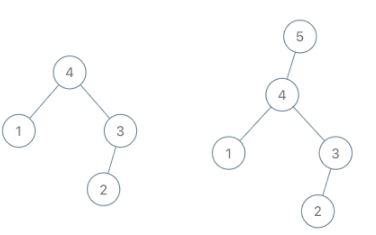
Input: root = [4,1,3,null,null,2], val = 5
Output: [5,4,null,1,3,null,null,2]
Explanation: a = [1,4,2,3], b = [1,4,2,3,5]
Example 2:
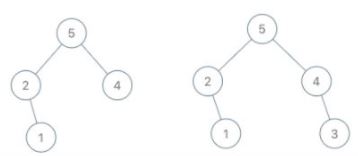
Input: root = [5,2,4,null,1], val = 3
Output: [5,2,4,null,1,null,3]
Explanation: a = [2,1,5,4], b = [2,1,5,4,3]
Example 3:
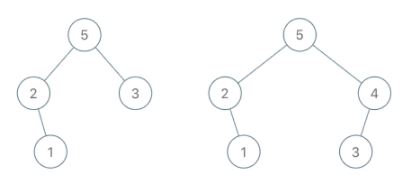
Input: root = [5,2,3,null,1], val = 4
Output: [5,2,4,null,1,3]
Explanation: a = [2,1,5,3], b = [2,1,5,3,4]
Constraints:
- The number of nodes in the tree is in the range
[1, 100]. 1 <= Node.val <= 100- All the values of the tree are unique.
1 <= val <= 100
Solution
/**
 * Definition for a binary tree node.
 * public class TreeNode {
 *     int val;
 *     TreeNode left;
 *     TreeNode right;
 *     TreeNode() {}
 *     TreeNode(int val) { this.val = val; }
 *     TreeNode(int val, TreeNode left, TreeNode right) {
 *         this.val = val;
 *         this.left = left;
 *         this.right = right;
 *     }
 * }
 */
class Solution {
    public TreeNode insertIntoMaxTree(TreeNode root, int val) {
        if (root == null) return new TreeNode(val);
        if (root.val < val) return new TreeNode(val, root, null);
        root.right = insertIntoMaxTree(root.right, val);
        return root;
    }
}
Complexity Analysis
- Time Complexity:
O(?) - Space Complexity:
O(?)
Approach
Detailed explanation of the approach will be added here